

The Other Side of the Page
The first time Ruth sent me a high five, it arrived in the mail. She had traced her hand onto a piece of paper from her cell, a substitute for the high five we could not actually exchange. Over the years, she has sent me more. She crochets, sends Bible verses, and nearly every letter begins in a way that has become so familiar that I can almost hear it before I read it: Good Morning and God Bless You.
Ruth is on death row.
I started writing to her in the fall of 2019, during my freshman year of college. I was eighteen years old and, if I am being generous to the person I was then, genuinely wanted to make the world a better place. There is a particular kind of confidence that comes with being eighteen and believing that if you care enough and show up enthusiastically enough, you can fix things you barely understand.
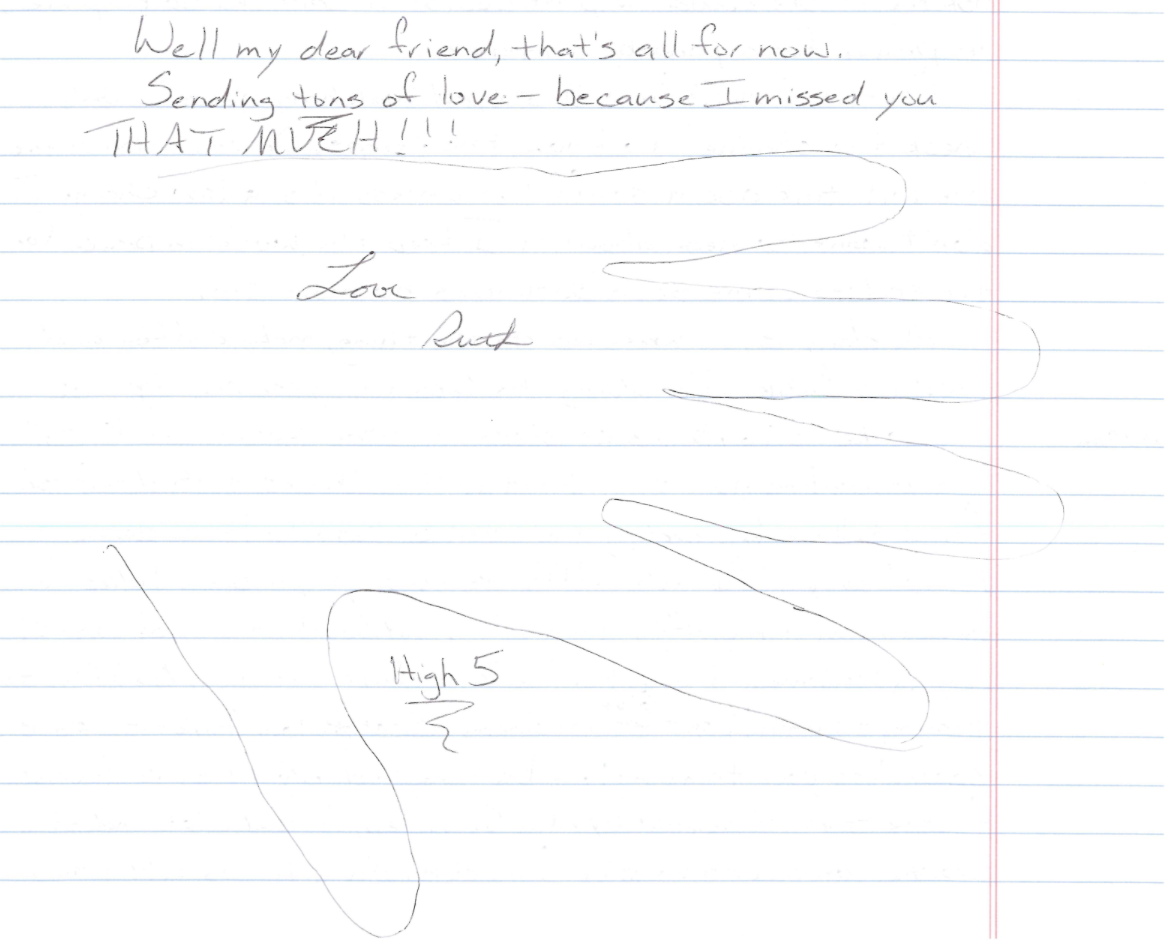
So I wrote a letter to a woman on death row. Ruth wrote back, and then I wrote back, and then she did. Nearly seven years later, there are hundreds of pages between us. There are conversations about life and death, regret and hope, faith and family, loneliness and incarceration.
But there are also traced hands, crochet projects, Bible verses, and jokes. There is advice I did not ask for and questions about my life. She writes about what she watched on television, what she ate, what she read, what annoyed her, and who she was worried about. There is, in other words, a relationship.
I started writing to Ruth because some part of eighteen-year-old me thought I might change her world. I did not understand how much she was about to change mine.
This year, as an Oklahoma Center for the Humanities Wonder Fellow, I have found myself returning to those letters.
Recently, I sat on the floor surrounded by more than seven years of correspondence while preparing to teach a university course I called Lessons from Death Row. As I reread letters I had not opened in years, I kept thinking about how different these pages are from most of the information we receive about incarcerated people.
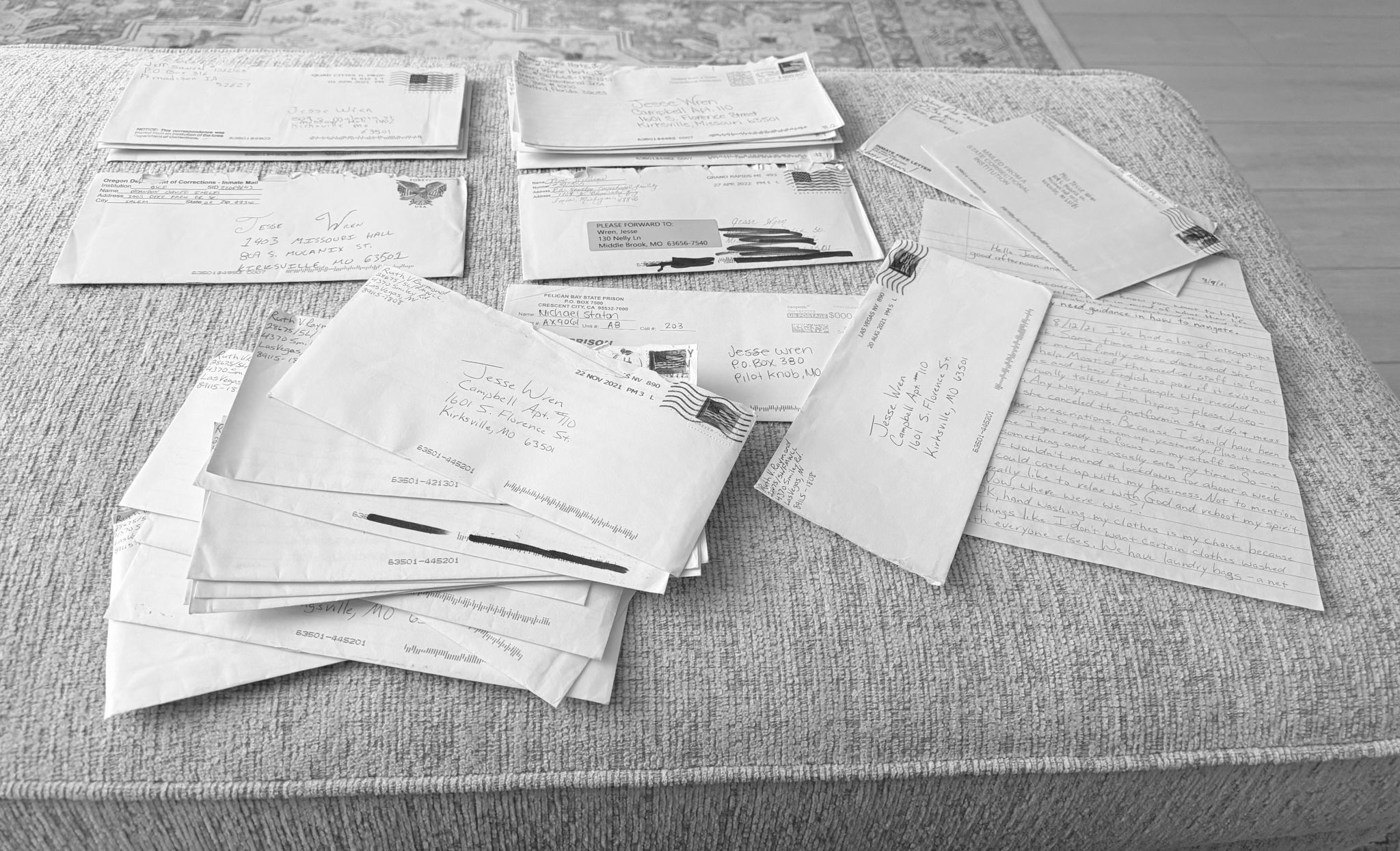
Paperwork can tell me someone’s name, Department of Corrections number, conviction, sentence, institution, and appeals. A letter tells me what book they are reading and their terrible jokes. It tells me who they are worried about, what they regret, what they are learning, and what makes them laugh.
Neither account is necessarily false, but one is profoundly incomplete. That distinction has become central to the way I think about wonder: What happens when we wonder about the people we think we already understand?
For someone on death row, we are often given an unusually powerful label: murderer. That word matters, as do the harm behind it and the lives of victims. Accountability matters too. Humanizing someone who has caused harm cannot require minimizing the harm itself, and empathy cannot require us to erase victims or pretend that difficult questions about justice have simple answers.
Humanizing someone is not the same as excusing them, and wondering about someone does not require declaring them innocent or agreeing with them. Maybe wonder is simply refusing to believe that one true thing about a person is the only true thing about them.
That idea has followed me far beyond my correspondence with Ruth. My relationships with incarcerated people began shaping the questions I asked as an educator and researcher and eventually led me toward work with justice-involved young people. Those threads came together in a nonprofit I founded called the Second Horizon Initiative.
The name came to me thousands of miles from Oklahoma while I was walking the Camino de Santiago in Spain. One morning, as the sun rose, I found myself thinking about what I wanted this work to become. A horizon looks like an ending, but you can keep walking toward it. Second Horizon became my way of describing something I had slowly come to believe: people deserve to be imagined beyond the chapter in which we encounter them.
Today, Second Horizon Initiative provides STEM programming for justice-involved youth in Tulsa. That sounds very polished when written in a mission statement. Our first visit was not.
We walked into a juvenile detention center carrying paper and gave two girls a simple challenge: build a chair out of it. We folded, failed, changed our designs, and tried again. Somewhere in the middle of it, the girls started laughing. Really laughing.
Afterward, staff told us they had never heard them laugh like that before. I have thought about that comment many times since because we hadn’t fixed anything that night. We hadn’t changed the circumstances that brought those young people into detention. For a little while, we had simply built something together and laughed.
Behind the walls and whatever paperwork existed about them somewhere in the building, there were two kids trying to make a chair out of paper. Maybe that should not have felt revelatory. The fact that it did says something about us.
I spend my days teaching elementary school students, and children are exceptionally good at wondering. They ask questions adults have learned not to ask. Sometimes their questions are profound, and sometimes they make absolutely no sense. But children have not yet completely learned our adult obsession with certainty.
We teach them categories because categories help us understand the world. Eventually, though, categories can become conclusions. We understand someone as the gifted student or the struggling student, the difficult kid or the successful one. Outside the classroom, we do the same thing with words like prisoner, victim, and offender. The categories may contain truth, but they can also begin to feel like the whole story.
Once we decide we know what someone is, we become less curious about who they are. Perhaps that is why my relationship with Ruth has affected my elementary classroom as much as it has affected my work around incarceration.
I used to think wonder was primarily about discovering something new. Now I wonder whether it is equally about becoming less certain of what we think we already know. For me, that has meant learning to stay curious a little longer and becoming more comfortable holding things that seem contradictory at the same time.
The irony is not lost on me. At eighteen, I began writing to someone on death row with a vague notion that I was going to do something good in the world. Nearly seven years later, I teach elementary school during the day and a course about incarceration at night. Those letters have led me into relationships I never imagined having, work with young people in detention centers, research, teaching, and eventually starting a nonprofit.
None of it looks like what eighteen-year-old me imagined when he put that first letter in the mail. I thought I was reaching across a divide to change someone else’s world. Instead, Ruth changed the questions I ask about mine. And lately, one question follows me everywhere: Who have I decided I already know?
I think about the student who is always in trouble, the difficult colleague, the neighbor, the person whose choices I cannot understand, and the stranger whose worst moment is the first thing I learn about them. Who do I stop wondering about because I think I already have enough information?
Maybe these letters were never only asking me to wonder about Ruth, people on death row, or even incarceration. Maybe they have been asking me to wonder about myself: the stories I accept, the labels I use, and the point at which I decide there is nothing more worth knowing.
Somewhere among the hundreds of pages I have accumulated since 2019 are outlines of Ruth’s hand. I have always thought of them as exactly what she intended them to be: high fives from a place where an actual high five between us was impossible. Lately, though, I have wondered about the image differently.
A handprint tells you almost nothing about a person. It cannot tell you what they have done or what has been done to them. It cannot tell you whether they are funny or difficult, remorseful or stubborn, hopeful or afraid. It cannot tell you whether you would like them, and it certainly cannot tell you what justice requires.
It only tells you that there is a person on the other side of the page.
Maybe wonder begins there.
I started writing believing I might make a difference in someone else’s life. Instead, it has repeatedly reminded me how much I do not know. As an educator, I am beginning to think my responsibility is not always to resolve that uncertainty, but to make room for it and resist allowing a label, even a true one, to become the end of a person’s story.
Nearly seven years after Ruth sent her first letter back to an eighteen-year-old who thought he might change the world, I am still opening her letters. I am still learning from them. And every once in a while, I still get a high five from the other side of the page.
Who becomes visible when we choose to wonder?